
India generates over 61,948 million litres of sewage every single day. Less than 37% gets treated before it reaches rivers or seeps into the groundwater your family drinks. Conventional septic tanks have been patching this problem for decades. But patching isn’t solving.
Bio septic tanks work differently. They don’t just hold waste — they treat it. Using living microorganisms and smart engineering, they transform raw sewage into harmless, reusable effluent. Once you understand the science, you’ll see why they’re not just a better option — they’re the only responsible choice for sustainable wastewater management in modern India.
What Is a Bio Septic Tank?
A bio septic tank is an on-site biological wastewater treatment system that uses naturally occurring bacteria, fungi, and enzymes to break down organic waste. Unlike conventional tanks that simply store sewage until a tanker pumps it out, bio septic tanks actively treat the water flowing through them — continuously, 24/7.
The “bio” isn’t a marketing term. It refers to a living ecosystem inside the tank that eats, digests, and neutralises harmful compounds in raw sewage.
| Treatment Process | Physical settling only | Biological + physical treatment |
| Odour | High | Minimal |
| Effluent Quality | Poor (high BOD/COD) | Meets CPCB norms |
| Maintenance | Desludging every 2–3 years | Every 3–5 years |
| Groundwater Safety | Leachate risk | Protected |
| Water Recycling | Not suitable | Reusable for irrigation |
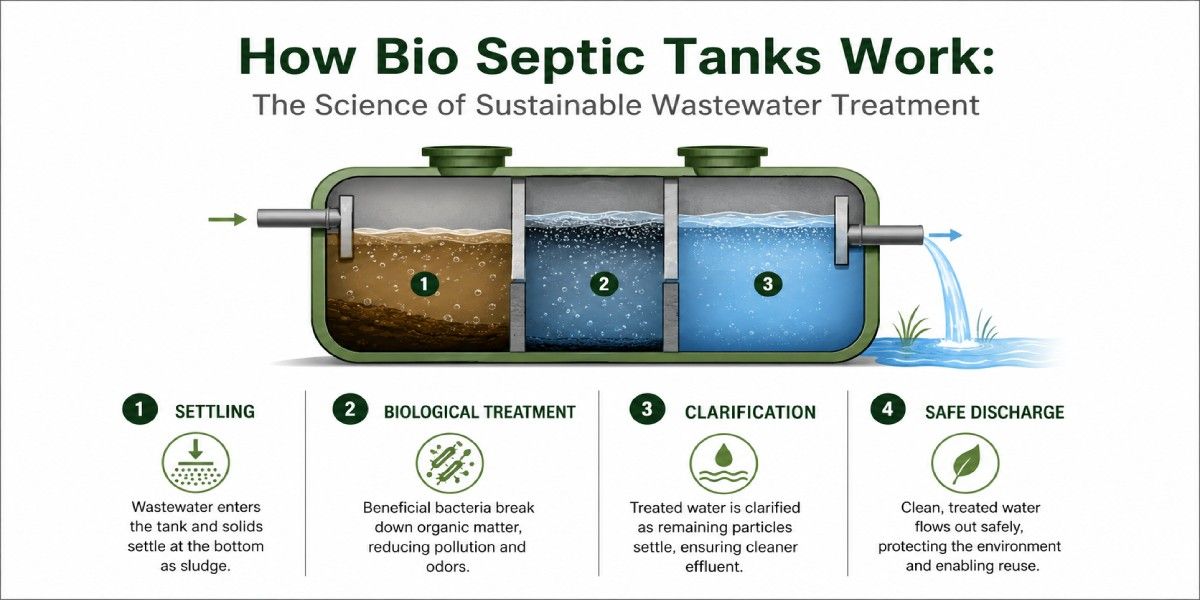
How Bio Septic Tanks Work — Step by Step
Step 1: Wastewater Enters and Settles
Raw sewage flows in by gravity. Heavy solids sink to form a sludge layer. Grease floats to the top. The middle liquid layer — partially clarified effluent — moves forward into the treatment zone.
Step 2: Anaerobic Digestion Begins
In the oxygen-free lower chamber, anaerobic bacteria break down organic solids through anaerobic digestion, producing CO₂, methane (biogas), and stabilised sludge. This stage alone reduces sludge volume by 50–70% compared to conventional tanks. In larger commercial systems, the biogas produced here gets captured and used as fuel — a genuine energy recovery benefit.
Step 3: Bio-Media Filter Bed — Where the Magic Happens
Effluent flows through a packed bed of specially designed bio-media — plastic rings, FRP structured packing, or ceramic surfaces. These materials provide enormous surface area for biofilm to colonise. Biofilm is a living layer of microbial colonies that consumes dissolved organic matter as wastewater passes through. More surface area = more bacteria = faster, more complete treatment.
Step 4: Aeration Zone
A small blower (50–200 watts for residential systems) injects air into the effluent, activating the aerobic bacterial community. These oxygen-loving bacteria consume dissolved organics far more aggressively than anaerobic bacteria alone. BOD drops from 200–300 mg/L in raw sewage down to just 10–30 mg/L at this stage — well within CPCB permissible limits.
Step 5: Clarification and Disinfection
Remaining suspended solids settle out in the clarification chamber. The final stage — UV disinfection or chlorination — kills residual pathogens. What exits the outlet pipe is visually clear, nearly odourless, and safe for garden irrigation or groundwater recharge.
Key Performance Numbers
| Parameter | Raw Sewage | Bio Septic Tank Outlet | CPCB Standard |
| BOD (mg/L) | 250–350 | 10–30 | ≤ 100 |
| COD (mg/L) | 500–700 | 50–100 | ≤ 250 |
| TSS (mg/L) | 200–350 | 20–40 | ≤ 100 |
A well-functioning bio septic tank reduces BOD by over 90%. That’s not just compliant — it’s genuinely clean water.
Why It Matters in India
The NGT requires on-site wastewater treatment for any building generating more than 10 KLD — with penalties reaching ₹25,000 per day for violations. The CPCB sets strict discharge standards that conventional tanks routinely fail to meet. In Tamil Nadu, TNPCB, CMDA, and DTCP increasingly demand compliant treatment documentation for building approvals.
Bio septic tanks don’t just protect the environment. They protect you — legally, financially, and practically.
Benefits at a glance:
- Groundwater protection — treated effluent, not raw leachate
- Water recycling — reuse treated water for irrigation, saving 20–30% on water costs
- Organic fertilizer potential — stabilised sludge enriches soil
- Lower long-term cost — less desludging, fewer breakdowns, no NGT fines
- Regulatory compliance — CPCB/NGT ready out of the box
The Bottom Line
Bio septic tanks put billions of years of microbial evolution to work — in a compact, engineered system that fits under your garden and outlasts your building. The science is proven. The regulations are clear. The days of burying a concrete box and hoping for the best are over.
Ready to upgrade your property’s wastewater system? Get a free site assessment and consultation today.
Leave a Reply