
Picture this. It’s Sunday morning. Guests arrive in two hours. And your septic system — the one you haven’t thought about in three years — decides today is the day it fails. That scenario plays out in households across India every single week. Here’s the frustrating truth: almost every one of those failures was completely preventable.
Bio septic tank maintenance isn’t complicated. It doesn’t demand specialist knowledge or expensive equipment. What it demands is consistency — a few smart habits, a scheduled annual service, and a basic understanding of what’s happening inside that tank buried in your yard. Get those right and your bio system will quietly do its job for 40–50 years without drama.
Why Bio Septic Tank Maintenance Is Different
A bio septic tank isn’t just a container. It’s a living ecosystem. Billions of microorganisms work together inside, breaking down waste through anaerobic digestion and aerobic biological treatment. These microbes are the engine of your entire wastewater management system. Everything about maintaining a bio septic tank comes back to one principle: protect the bacteria.
That’s what separates bio septic tank maintenance from looking after a conventional concrete tank. With a conventional system, maintenance is largely mechanical. With a biological system, you’re managing a microbial community. The chemicals you pour down the drain, the amount of water you use daily, the cleaning products under your sink — all of it affects that community directly.
Your Complete Bio Septic Tank Maintenance Schedule
Daily Habits That Do the Heavy Lifting
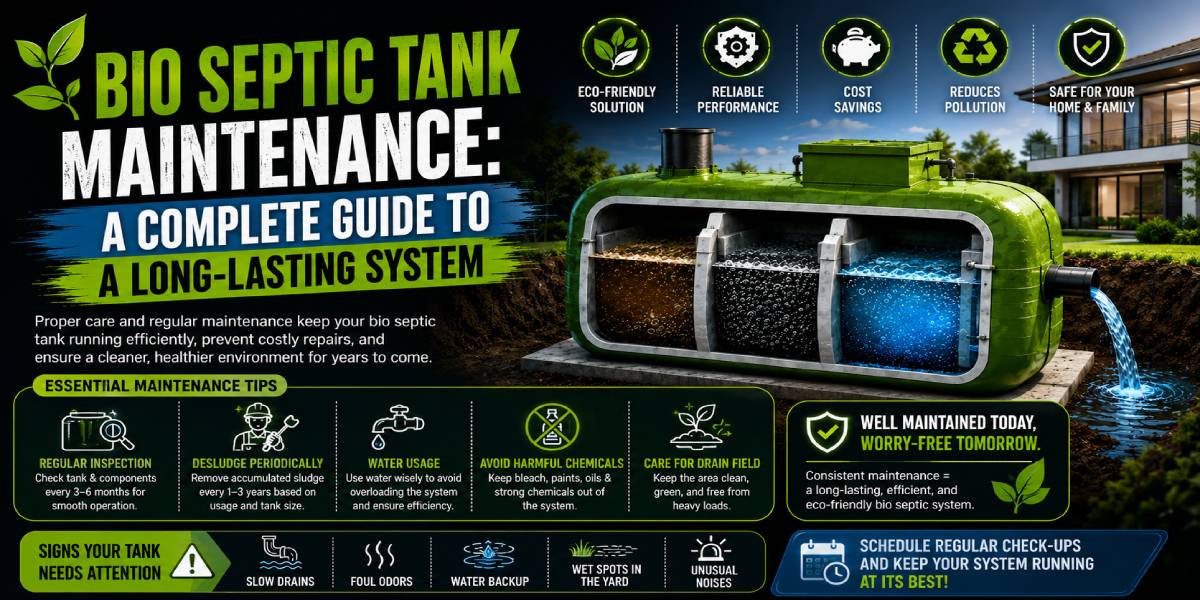
The most powerful maintenance tool you have costs nothing. It’s simply being mindful of what goes down your drains. Never pour cooking oil or grease into the sink. Spread laundry loads across the week rather than six loads in a single day — sudden hydraulic overloading flushes partially treated effluent through before the bacteria finish working. Use eco-friendly, phosphate-free detergents. In Indian households specifically, avoid phenyl — it’s acutely toxic to the microbial colony your system depends on.
Weekly (5 Minutes)
- Walk past the tank — any odour? Any wet patches?
- Listen for the aeration pump hum (ATU systems)
- Check drain speed inside the house
- Glance at the control panel — all lights green?
Every 6 Months
Clean the effluent filter — the single most neglected component in any bio system. Remove it carefully, rinse with tank effluent (not clean water or disinfectant — you want to preserve the biofilm), inspect for damage, and reinstall. This one task prevents more leach field failures than anything else.
Annual Professional Service
Book it every year without exception. A proper service covers sludge depth measurement, effluent quality assessment, aeration system performance, filter inspection, leach field check, and a written report. Average annual service costs across India:
| Metro cities (Mumbai, Bengaluru, Delhi) | ₹2,500 – ₹5,000 |
| Tier 2 cities (Coimbatore, Kochi, Nagpur) | ₹1,500 – ₹3,500 |
| Rural areas | ₹1,000 – ₹2,500 |
Every 4–8 Years — Pump-Out
When sludge occupies more than 30% of the primary chamber, it’s time. Don’t just go by the calendar — let your technician’s sludge measurement guide the decision. Pump-out costs range from ₹3,000 for small tanks to ₹20,000+ for larger systems. Properly processed sludge can even be converted into organic fertilizer — closing the nutrient loop entirely.
What Never Goes Down the Drain
| Bleach / phenyl / disinfectants | 🔴 High — kills bacterial colony |
| Cooking oils and fats | 🔴 High — overwhelms primary chamber |
| Wet wipes and sanitary products | 🔴 High — blocks pipes, won’t break down |
| Medications and antibiotics | 🔴 High — toxic to microbial community |
| Excessive food waste | 🟡 Medium — overloads settlement chamber |
| Eco-friendly cleaning products | ✅ Safe |
Warning Signs You Shouldn’t Ignore
- Slow drains across multiple fixtures — effluent filter blocked or pump-out overdue
- Odour near the tank or leach field — bacterial imbalance or aeration failure
- Alarm light on the control panel — reduce water use immediately and call your technician
- Wet or soggy ground near the tank — effluent surfacing; leach field under stress
- Unusually lush green grass over the tank — effluent reaching root zone too early
Act on these promptly. Caught early, most issues cost ₹3,000–₹8,000 to fix. Left alone, they escalate to leach field replacement at ₹1,50,000–₹5,00,000.
Monsoon Season — India-Specific Checklist
Heavy rainfall creates two risks: groundwater infiltration into the tank and surface water overloading the inlet. Every May, before the rains arrive:
- Inspect all tank lid seals and access covers
- Confirm ground drainage directs water away from the tank
- Check the vent pipe is clear and properly capped
- Ensure the leach field area has adequate drainage
The 5 Habits of Homeowners With Long-Lasting Systems
- ✅ Never pour bleach, phenyl, or disinfectants down drains
- ✅ Spread laundry loads — never overwhelm the system in a single day
- ✅ Book the annual professional service every year
- ✅ Clean the effluent filter every 6 months
- ✅ Act on early warning signs — never wait to see if a problem resolves itself
The Bottom Line
Bio septic tank maintenance costs ₹10,000–₹28,000 per year in routine upkeep. Neglect costs ten times that — and sometimes far more. A well-maintained system protects your groundwater, your property value, your family’s health, and the local ecosystem for decades.
The biology does the work. Your job is simply not to get in its way.
Need a professional service? Contact a certified wastewater technician and ask for a full system health assessment. Bring your maintenance history — a good technician uses that information to give you a far more accurate picture of your system’s condition.
Leave a Reply