
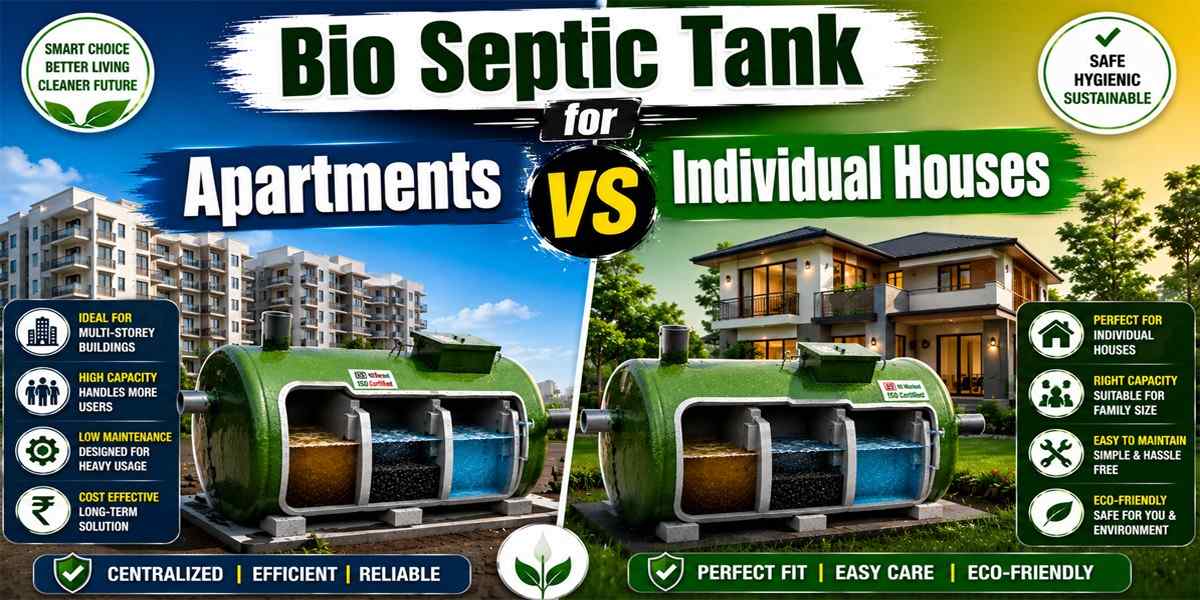
Choosing the right bio septic tank for home installations requires understanding the fundamental differences between apartment complexes and individual houses. Whether you’re a homeowner, apartment resident, or property developer, selecting appropriate septic solutions for homes demands careful consideration of building type, usage patterns, and infrastructure requirements. This guide explores how apartment septic system needs differ from standalone homes and helps you make informed decisions.
Understanding the Core Differences
Bio septic tanks function on the same biological principles regardless of property type, but their implementation varies dramatically between apartments and individual houses. Scale, management responsibility, space constraints, and regulatory requirements create distinct challenges and opportunities for each setting.
Individual houses offer autonomy in design, installation, and maintenance decisions. Homeowners control their entire wastewater management system, from selection to servicing. Apartments, conversely, require collective solutions serving multiple households simultaneously, demanding coordinated planning and shared responsibility.
Capacity Requirements: Size Matters
The most obvious difference between apartment and individual house systems lies in capacity requirements.
Individual House Systems:
A typical single-family home with 4-5 residents requires a bio septic tank for home ranging from 1,500 to 2,500 liters. Calculations are straightforward: multiply household members by 150-200 liters daily water usage, then factor in two to three days of retention time.
Homeowners enjoy flexibility in sizing. A growing family can plan for future needs, installing a slightly larger tank upfront. Weekend homes use smaller systems, while joint families require expanded capacity. This customization makes individual house installations relatively simple.
Apartment Complex Systems:
Apartment buildings face exponentially complex calculations. A 20-unit building with average occupancy of 4 persons per unit generates approximately 12,000-16,000 liters of wastewater daily. This requires communal tanks of 30,000-50,000 liters or more.
The apartment septic system must account for peak usage times when multiple households simultaneously use water during morning and evening hours. This creates surge flows that smaller systems cannot handle, necessitating larger buffer capacities than simple calculations suggest.
Many modern apartment complexes install multiple interconnected tanks rather than single massive units, providing redundancy and easier maintenance access.
Space and Installation Considerations
Space availability dramatically impacts septic solutions for homes in different property types.
Individual Houses:
Standalone homes typically have dedicated outdoor space for septic tank installation. Tanks can be placed in backyards, side yards, or gardens with relative ease. Homeowners choose optimal locations balancing accessibility for maintenance, distance from living areas, and proximity to drainage fields.
Installation is straightforward, involving excavation in the chosen location, tank placement, connection to household plumbing, and backfilling. The process typically takes 2-3 days for standard installations.
Ground-level access allows easy maintenance vehicle entry for periodic desludging. There’s also freedom to expand or modify the system if future needs change.
Apartment Buildings:
Space constraints in apartments create significant challenges. Urban apartment complexes often have limited ground space, with most areas occupied by parking, gardens, or amenities.
Many buildings install apartment septic system components underground beneath parking areas or common spaces, requiring careful structural planning during construction. Retrofitting existing apartments proves even more challenging, sometimes necessitating creative solutions like rooftop installations or compact modular systems.
Multi-story buildings require robust internal plumbing to collect wastewater from all floors and direct it to ground-level treatment facilities. Gravity flow systems work for lower floors, but high-rises may need intermediate collection points and pumping systems.
Cost Implications
Financial considerations differ substantially between property types.
Individual House Costs:
Homeowners bear complete installation costs, typically ranging from ₹40,000 to ₹1,20,000 depending on capacity and materials. While this seems expensive, it’s a one-time investment with clear ownership.
Maintenance costs are predictable and controllable. Homeowners schedule desludging every 3-5 years (₹3,000-8,000) and handle minor repairs as needed. There’s no dependency on others or association politics affecting service quality.
Apartment Complex Costs:
Large apartment septic system installations cost ₹3,00,000 to ₹15,00,000 or more, but this divides among multiple units. A 30-unit building might spend ₹6,00,000, averaging ₹20,000 per apartment—comparable to individual house costs.
However, ongoing management costs prove more complex. Apartment associations collect monthly maintenance fees covering system upkeep, professional management, and eventual repairs. Cost-sharing disputes arise when residents disagree about maintenance frequency or quality.
Management and Maintenance
The management structure fundamentally differs between property types.
Individual House Management:
Homeowners enjoy complete autonomy. They choose service providers, schedule maintenance according to personal preferences, and implement water conservation measures that directly benefit their system’s longevity.
This independence also means complete responsibility. Neglecting maintenance harms only your property, but failure to act promptly can create expensive problems.
Apartment Management:
Apartments require collective decision-making through resident welfare associations or management committees. Professional facility managers often handle day-to-day operations, ensuring consistent maintenance schedules.
This professional management provides expertise many individual homeowners lack. However, it also means compromising on personal preferences and adhering to association schedules and approved vendors.
Shared systems create accountability challenges. When problems arise, identifying responsibility—individual misuse versus system failure—can spark disputes.
Regulatory Compliance
Both property types must meet government standards, but enforcement differs.
Individual Houses:
Municipal authorities require compliance during building plan approval and occupancy certificate issuance. Once operational, oversight is minimal unless complaints arise or visible problems occur.
Homeowners must ensure their bio septic tank for home meets IS 2470 standards and NBC requirements, but daily compliance verification rarely happens.
Apartment Buildings:
Multi-unit buildings face stricter scrutiny. Authorities conduct regular inspections, require detailed compliance reports, and may impose penalties for violations affecting multiple households.
Many states mandate professional certification of apartment septic system installations, with engineers signing off on design and construction quality. Environmental clearances become necessary for large complexes.
Making the Right Choice
Whether selecting a bio septic tank for home or an apartment septic system, understanding these fundamental differences ensures appropriate solutions.
Individual homeowners prioritize sizing accuracy, quality materials, and reliable installation. They should invest in systems slightly larger than minimum requirements and establish relationships with dependable service providers.
Apartment residents should actively participate in association decisions, understand shared system capabilities and limitations, and support adequate maintenance budgeting. Choosing apartments with well-designed, professionally managed wastewater systems prevents future headaches.
Both scenarios benefit from bio septic technology’s efficiency, environmental benefits, and long-term cost savings. The key is matching system design to property type, ensuring septic solutions for homes serve occupants effectively for decades while protecting community health and environmental quality.
Leave a Reply